
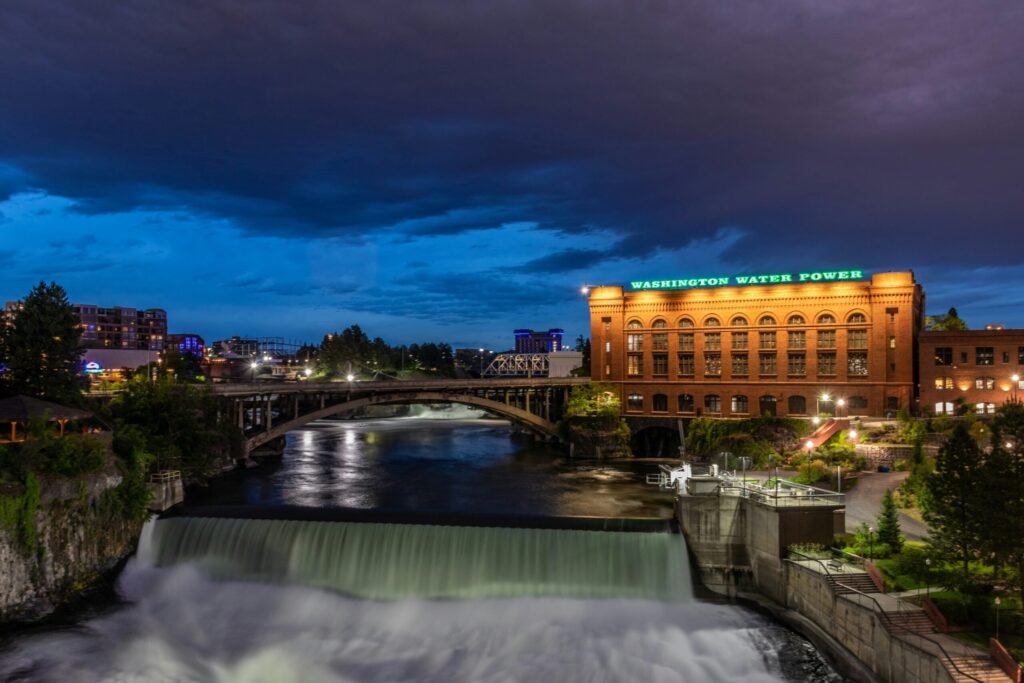
 Photo by Clay Elliot
Spokane recorded 2,826 traffic crashes in 2025. Twenty-one of them were fatal. More than 970 people were injured across all levels of severity, a ratio that matters in a city this size: roughly one out of every three crashes involved an injury, and one in every 135 ended in a death.
What stands out immediately is where those deaths occurred. The fatal locations trace a familiar map: North–south arterials, commercial corridors, highway access points, and transitional spaces—parking lots, park entrances, school fronts—where speed, visibility, and human movement intersect.
North Nevada Street appears repeatedly. So does Division Street, Francis Avenue, and the I-90 corridor. These are Spokane’s daily routes.
A Decade Trend, Not a One-Year Drop
Spokane’s crash numbers show a clear downward trend. Total crashes dropped from 4,383 in 2019 (the highest point of the last decade) to 4,131 in 2021, 4,080 in 2022, 3,680 in 2024, and 2,954 in 2025—a 32% decrease from the pre-COVID peak and nearly a 20% drop in just the last two years. This reflects a longer shift that points toward real structural change in how risk is managed across the city. Even alcohol-involved crashes follow the same deceleration trend,
Fatal Crashes Were Spread But Not Random
The 21 fatal crashes were distributed across north Spokane, downtown edges, westside arterials, and south hill green spaces. Several patterns emerge:
- North Spokane arterials (Nevada, Division, Market) account for a disproportionate share of fatalities, including multiple pedestrian deaths.
- Commercial parking lots were not immune. One fatal crash occurred inside a lot at N Nevada St & E Magnesium Rd—the same area tied to a teen-driver fatality later in the year.
- Curves, highway exits, and frontage roads—from Sunset Highway to High Drive Park—appear repeatedly.
On one Thursday night alone, two pedestrians were killed within three hours near Nevada Street. One was struck while crossing near Gordon Avenue before 6:15 p.m. The other died later that night in the parking lot near Magnesium Road, still pinned under a pickup when firefighters arrived.
Pedestrians: Fewer Crashes, Higher Stakes
Spokane recorded 148 pedestrian crashes in 2025. That is only 5% of all crashes, yet pedestrians accounted for more than half of all traffic deaths:
- 12 of the city’s 21 fatalities were pedestrians
- 27 suffered suspected serious injuries
- 103 sustained moderate to minor injuries
Age matters here. The most affected group was 15–20-year-olds (25 victims), followed closely by children under 15 (19 victims). Nearly one-third of all pedestrian crashes involved school-age youth, pointing toward commuting hours, crossings near schools, and arterial routes that double as neighborhood streets.
Alcohol was a factor in five pedestrian crashes, including a fatal hit-and-run on Division Street near E Dalton Avenue at 2:20 a.m. on a Saturday.
Distracted and Impaired Driving Overlap More Than It Seems
Police recorded 501 distracted-driving crashes. Only 17 officially involved cellphone use, but distraction still produced:
- 3 fatalities
- 11 serious injuries
- 65 moderate to minor injuries
Alcohol-involved crashes totaled 179, including 2 fatalities, 22 serious injuries, and 62 moderate injuries. Both fatal alcohol crashes occurred on weekend mornings—Saturday pre-dawn and Sunday morning—when traffic is lighter but speeds are higher.
Teen Driving Alert
Teen drivers deserve separate attention. They were responsible for 355 crashes, including 4 fatalities and over 110 moderate-to-severe injuries. One of those fatal crashes occurred inside the same Nevada–Magnesium commercial area where a pedestrian would later be killed, tying youth, commercial access roads, and late-hour driving into the same geographic narrative.
Motorcycles: Visibility Was Not the Issue
Motorcycles were involved in 85 crashes, with 6 fatalities. What stands out is timing:
- 5 of the 6 fatal motorcycle crashes happened during daylight hours
- Only one occurred at night
Visibility was not the primary problem. Speed differentials, road design, and interaction with larger vehicles likely played a larger role—something underscored by a fatal I-90 incident involving a sheriff’s sergeant assisting a stranded driver.
In August, while helping remove a fallen hay bale near the Four Lakes exit, Sgt. Salas was struck and killed by a motorcyclist attempting to maneuver around a blocked lane. It happened at 7:50 a.m., in daylight, with emergency lights activated. The corridor mattered. The margin for error was gone.
Buses, Trucks, and the Cost of Scale
Spokane logged 55 bus-involved crashes and 143 truck-involved crashes. Most were non-fatal, but scale changes consequences.
A charter bus crash on State Route 28 killed three people, including two teenagers in a passing car and the bus driver. Eight passengers were hospitalized, one later dying from injuries. One mistake, one maneuver, multiplied by mass.
What the Data Suggests
Spokane’s 2025 crash data does not point to chaos. It points to predictable risk:
- Arterials that serve as both highways and neighborhood streets
- Parking lots and access roads treated like low-risk spaces
- Youth and pedestrians concentrated along the same corridors
- Daylight crashes driven by speed and volume, not darkness
The numbers do not describe rare events. They describe daily movement patterns, repeated often enough that when something goes wrong, it goes wrong in the same places.
The crash figures cited in this article come from the Washington State Department of Transportation (WSDOT) Collision Data Portal, which compiles law enforcement–reported crashes across Washington.
👉 Contact our Spokane office today.
Stay Updated — Follow Us on Instagram
View this profile on Instagram