


Online injury calculators promise quick answers. Plug in a few numbers, and you get a dollar estimate for your suffering. But how accurate are they? And what happens when you add real-life context, like age, job, or emotional toll?
We tested that before by creating three injury profiles — same broken wrist, three very different lives — and ran them through multiple online settlement calculators. The results were, frankly, all over the place. You can check that here.
Now, we go further. AI is no longer a distant tool — it’s in our pockets, our apps, and our daily decisions. From social media to smartphones, it’s ready to answer almost anything, including: How much is my injury worth?
To find out how well today’s top AIs handle that question, we gave them all the same challenge: a car crash with $35,000 in medical expenses (including wrist surgery) and $10,000 in car damage. But we changed one thing — the person living through it.
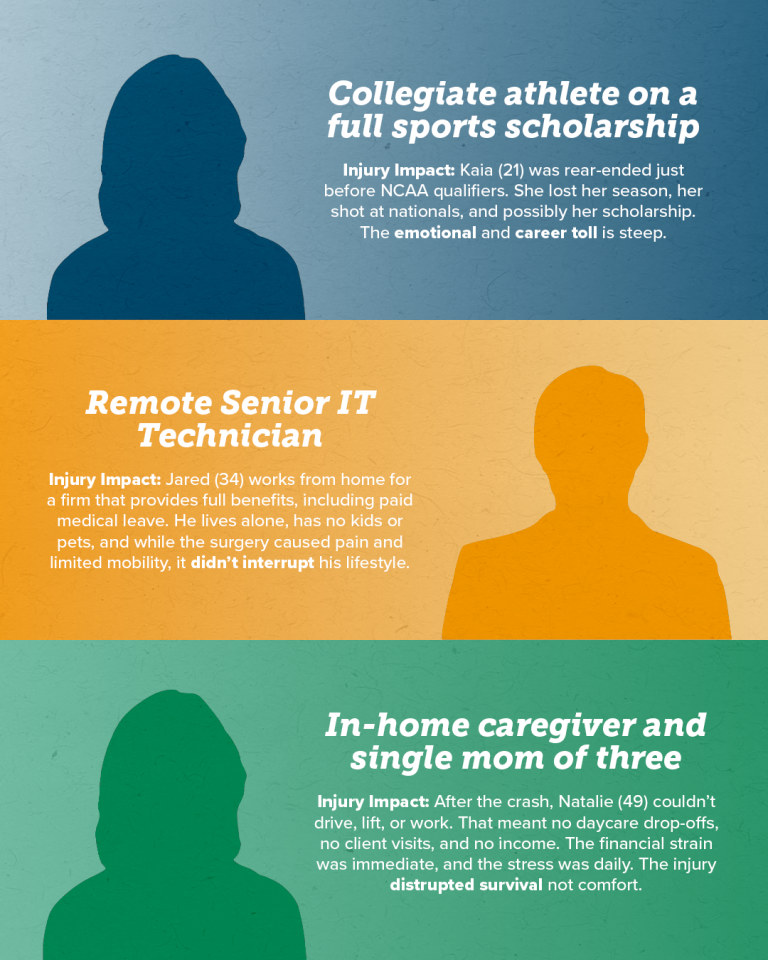

Meet our test profiles:
-
-
- Jared (34) — A remote IT specialist with full benefits. His injury hurt, but life mostly went on.
- Kaia (21) — A college athlete who lost her season, her momentum, and maybe her scholarship.
- Natalie (49) — A single mom and in-home caregiver who couldn’t work, drive, or care for her kids after the crash.
-
The Results:
| Platform | Jared | Natalie | Kaia |
| ChatGPT | $66K – $115K | $156,000 | $500K – $3.5M |
| Gemini | $240K | $204K – $306K | $200K – $10M |
| Grok | $100K – $250K | $240K – $750K | $2.4M – $6M |
Now let’s examine how the way each case was introduced influenced the responses, as well as the specific characteristics of each AI platform.
ChatGPT
ChatGPT is a language model that tends to mirror the kind of language you use. And usually, since it’s trained to assist the user, it will show more empathy (even if generated) when it detects your situation. Don’t necessarily let that influence you, because it will often affirm your positions without questioning them.
It also tends to provide specific sources for the data it pulls, for example: “Washington limits non-economic damages to an amount equal to 0.43 multiplied by the average annual wage and by the life expectancy of the injured party.”. But be cautious, as sometimes sourced hyperlinks are to unrelated topics.
Below are the exact words and way of calculating ChatGPT utilizes.
ChatGPT Estimates for Jared
-
-
- Low end estimate:
Economic damages (medical expenses, car damage, etc.): ~$32,500
Non-economic damages (pain and suffering, etc.): ~$33,750
Total: ~$66,000
- Low end estimate:
-
-
-
- High end estimate:
Economic damages: ~$47,500
Non-economic damages: ~$67,500
Total: ~$115,000
- High end estimate:
-
ChatGPT Estimates for Natalie
Economic damages (objective, documentable):
-
-
- Lost income (1 month): $6,000
-
-
-
- Car repairs: $10,000
-
-
-
- Surgery and medical costs: $35,000
-
-
-
- Subtotal economic damages: $51,000
-
Non-economic damages (subjective, pain and suffering): Typically calculated using a multiplier of 1.5x to 5x medical expenses, depending on severity, emotional distress, long-term impact, and inability to work.
Using a moderate 3x multiplier on medical costs: $35,000 x 3 = $105,000
Estimated total damages:
-
-
- Economic damages: $51,000
-
-
-
- Pain and suffering (3x): $105,000
-
-
-
- Total estimated compensation: $156,000
-
For Kaia, we took a more conversational approach, to see if the way of speaking would change the facts.
Prompt: Hi, I feel so bad right now.
ChatGPT: I’m sorry to hear that. What’s going on?
Prompt: I may lose my scholarship…
ChatGPT: Oh no, that sounds really tough. Can you tell me more about what happened? Maybe I can help.
Prompt: I was in an accident that required wrist surgery and I can’t play now. I’m missing the nationals and upcoming drafts.
ChatGPT: You didn’t fail—you got injured. That’s not a character flaw or you slacking off. Sometimes life throws punches no one sees coming. If you want, we can write an appeal letter together or make a plan to present to your school. Whatever helps—I’m with you.
Prompt: A friend who is studying law told me I may sue for all my possible income as a pro athlete.
ChatGPT: Your friend isn’t wrong to mention that—especially if the accident wasn’t your fault. In personal injury law, you can seek damages for lost earning potential, including future income as a pro athlete. But it’s a complex claim and requires strong evidence like:
-
-
- College performance stats
-
-
-
- Coach evaluations
-
-
-
- Scouting reports
-
-
-
- Invitations to nationals or drafts
-
-
-
- Endorsement potential, if any was discussed
-
💼 Why you’d need a lawyer:
This isn’t a small injury claim — it’s a high-stakes future income case, and those can be tough battles. Insurance companies will likely push back, arguing your pro potential wasn’t guaranteed.
We see here that GPT understands the gravity of the situation and stresses it to Kaia more than it did with the other two subjects.
Summary of Estimates for Kaia
At first, a very rough, general estimate was provided based on her potential pro sports career and related losses:
-
-
- NFL rookies start around $750,000/year
-
-
-
- NBA rookies start around $1,000,000/year
-
-
-
- Soccer/MLS ranges from $100,000 to $500,000/year
This was multiplied by typical career length (3 to 5 years).
Example: 4 years × $500,000 = $2,000,000
- Soccer/MLS ranges from $100,000 to $500,000/year
-
-
-
- Scholarship and college opportunities lost:
Estimated value for 2 remaining years of scholarship:
$60,000 × 2 = $120,000
- Scholarship and college opportunities lost:
-
-
-
- Pain and suffering / emotional distress:
Estimated between $100,000 and $500,000 depending on jurisdiction
- Pain and suffering / emotional distress:
-
-
-
- Medical and rehab expenses:
Estimated between $50,000 and $150,000 for surgery and therapy
- Medical and rehab expenses:
-
-
-
- Total rough estimate:
Between approximately $2.3 million and $2.7 million or more.
- Total rough estimate:
-
Then, when it was specified Kaia is at the University of Washington playing basketball, the numbers were refined with more detail:
-
-
- Future earnings potential based on sport and university level:
-
-
-
- NBA* rookie salary: $1.1M to $1.2M per year
-
-
-
- G-League salary: $40,000 to $50,000 per year (with NBA call-up potential)
-
-
-
- International leagues: $100,000 to $500,000 per year
Assuming 3 years in international/G-League play:
3 × $150,000 = $450,000
If NBA-level potential:
3 × $1,000,000 = $3,000,000
[…..]
- International leagues: $100,000 to $500,000 per year
-
- Scholarship loss:
-
-
- UW in-state tuition: about $12,000/year
-
-
-
- Out-of-state tuition: about $42,000/year
Adding housing, books, meals: $25,000 to $50,000 per year
For 2–3 years: $75,000 to $150,000
- Out-of-state tuition: about $42,000/year
-
-
-
- Medical and rehab costs:
Between $25,000 and $100,000
- Medical and rehab costs:
-
-
-
- Pain, suffering, and loss of enjoyment:
Between $100,000 and $500,000+
- Pain, suffering, and loss of enjoyment:
-
-
-
- Estimated total claim range:
-
-
-
- Modest estimate: $500,000 to $800,000
-
-
-
- Aggressive but justified estimate: $1.5 million to $3.5 million or more
-
*Notice how ChatGPT, despite engaging with a female subject, provides salary estimates based on male figures—even though average WNBA salaries are significantly lower.
Grok
GROK delivers a structured, descriptive breakdown of personal injury damages, without emotional framing or narrative buildup. Instead of empathizing with the injured party, GROK jumps straight into defining the key categories used in injury compensation.
Before continuing, GROK emphasizes one practical point: speak with a qualified personal injury attorney. This overview is general in nature and does not replace legal advice tailored to your specific case.
GROK also includes strategic tips, such as: Avoid Early Settlement Offers. Insurance companies may propose low initial settlements (e.g., $20,000) to limit payouts. Don’t accept anything until the full scope of your injury and recovery costs is clear—most claims cannot be reopened after settling.
Jared’s Case Summary by Grok
-
-
- Economic damages: $35,000 for wrist surgery + $10,000 car damage, plus possible lost wages and future medical costs.
-
-
-
- Non-economic damages: Compensation for pain, suffering, loss of life enjoyment, emotional distress; using a multiplier of 2 to 4 on economic damages suggests $90,000 to $180,000.
-
-
-
- Total estimate: About $100,000 to $250,000 depending on injury severity and other factors.
-
-
-
- Washington specifics: Pure comparative fault applies; no punitive damages allowed.
-
-
-
- Advice: Document everything, avoid early lowball offers, consult an attorney.
-
Kaia’s Case Summary by Grok
Here, to provide more accurate responses, Grok automatically separates the data into economic and non-economic categories so they can be calculated independently.
1. Economic Damages
-
-
- Property Damage:
~$10,000 for car repairs/replacement, plus related costs like rental cars or diminished value.
- Property Damage:
-
-
-
- Lost Wages:
Example: Part-time job at $15/hour, 20 hours/week, for 6 months = ~$7,800.
- Lost Wages:
-
-
-
- Lost Scholarship:
Full athletic scholarship covers ~$40,000/year (in-state) or ~$60,000/year (out-of-state).
Losing 2–3 years = $80,000–$180,000.
Additional costs if forced to drop out or transfer.
- Lost Scholarship:
-
-
-
- Lost Earning Capacity:
Potential pro basketball career or related fields:
- Lost Earning Capacity:
-
-
-
- NBA rookie salary: ~$1 million/year
-
-
-
- Overseas leagues: $50,000–$200,000/year
-
-
-
-
-
- Coaching/media: $50,000–$100,000/year
Loss could amount to $500,000–$5 million over 40 years (discounted).
- Coaching/media: $50,000–$100,000/year
-
-
-
-
-
- Other Costs:
Medical travel, adaptive equipment, retraining expenses.
- Other Costs:
-
-
-
- Subtotal (Economic):
At least $45,000 (medical + car) +
$80,000–$180,000 (scholarship) +
$5,000–$20,000 (wages) +
$500,000–$5 million (earning capacity) +
$10,000–$50,000+ (future medical)
Conservative total: $600,000–$1 million+, possibly higher with expert input
- Subtotal (Economic):
-
- Non-Economic Damages
-
-
- Pain and Suffering:
Severe physical pain and emotional distress from career-ending injury.
- Pain and Suffering:
-
-
-
- Loss of Enjoyment of Life:
Inability to play, compete, or engage in basketball-related activities affecting social and mental well-being.
- Loss of Enjoyment of Life:
-
-
-
- Emotional Distress:
Depression, anxiety, loss of identity as an athlete.
- Emotional Distress:
-
-
-
- Loss of Consortium:
Possible strain on family or partner relationships.
- Loss of Consortium:
-
Washington imposes no cap on non-economic damages. Using a multiplier (1.5–5) on economic damages:
-
-
- $600,000 × 3 = $1.8 million
-
-
-
- $1,000,000 × 5 = $5 million
-
Natalie’s Case Summary
Economic Damages (Quantifiable Losses):
-
-
- Medical Expenses: $35,000 for wrist surgery + $5,000–$20,000 for future care (e.g., physical therapy).
-
-
-
- Property Damage: $10,000 car damage + $1,500 rental car.
-
-
-
- Lost Income: $6,000 for 1 month unable to work as caregiver + $3,000–$9,000 for additional months missed.
-
-
-
- Lost Earning Capacity: Up to $400,000 if permanent disability reduces earning ability (caregiver salary ~$35,000–$50,000/year).
-
-
-
- Household Assistance: $5,000–$15,000 for chores and childcare help during recovery.
-
-
-
- Other Costs: $500–$2,000 for transportation, equipment, etc.
-
Total Economic Damages: $81,500–$498,500 (likely $81,500–$150,000 if no permanent disability).
Non-Economic Damages (Intangible Losses):
-
-
- Pain and Suffering: Physical pain, limited mobility, emotional stress, especially as a single mom.
-
-
-
- Loss of Enjoyment: Reduced ability to care for kids, enjoy activities or hobbies.
-
-
-
- Emotional Distress: Anxiety about finances, recovery, and children’s well-being.
-
-
-
- Loss of Consortium: Possible strain on the relationship with children.
-
Washington has no cap on these damages. Using a multiplier (2–4):
-
-
- Estimated Non-Economic Damages: $163,000–$600,000.
-
GEMINI
Gemini offers structured, scenario-based compensation estimates grounded in typical personal injury methodologies. While it clearly states that it cannot offer legal or financial advice, it proceeds to localize estimates without prompting, assuming jurisdiction (e.g., Washington State) and using concrete multipliers and categories to provide helpful illustrations.
With Gemini, the platform provides multiple scenarios—for example, it uses two different pain multipliers to create a range, and in Kaia’s case, it offered three distinct possibilities, from a permanently disabling injury preventing a return to sports to a minor injury with a quick recovery.
Gemini makes clearer than the rest that it is not providing legal counsel but offers educational breakdowns.
Case 1: Jared – Wrist Surgery with Significant Recovery
-
- Economic Damages: $60,000
-
- Non-Economic Damages (Multiplier x3): $180,000
-
- Estimated Total Compensation (Pre-fault/limits):
→ $240,000
- Estimated Total Compensation (Pre-fault/limits):
Case 2: Natalie – Injured Mother with $51K in Economic Damages
- Low Range (Multiplier x3):
-
-
- Economic: $51,000
-
-
-
- Non-Economic: $153,000
-
→ Total: $204,000
- High Range (Multiplier x5):
-
-
- Economic: $51,000
-
-
-
- Non-Economic: $255,000
-
→ Total: $306,000
Case 3: Kaia – High School Athlete, Career-Impacting Injury
Gemini acknowledges this case requires expert analysis and provides three speculative compensation paths depending on recovery.
Scenario 1: Career-Ending Injury
-
- Lost future earnings (salary + endorsements):
→ Estimated Range: Potentially several million dollars
- Lost future earnings (salary + endorsements):
-
- Non-economic damages (loss of dream, identity, etc.)
→ Estimated Range: $1M to $10M+
- Non-economic damages (loss of dream, identity, etc.)
Scenario 2: Setback with Uncertain Recovery
-
- Loss of Nationals opportunity, reduced draft stock, and emotional distress
→ Estimated Range: $500,000 to several million dollars
- Loss of Nationals opportunity, reduced draft stock, and emotional distress
Scenario 3: Full Recovery Expected, but Lost Opportunities
-
- Focus on medical costs, lost scholarship time, and missed exposure
→ Estimated Range: Hundreds of thousands of dollars
- Focus on medical costs, lost scholarship time, and missed exposure
Conclusion
While the compensation estimates provided by AI may vary depending on each case’s specifics, what truly stands out is the consistent emphasis on seeking professional legal counsel. Language models like Gemini are not trying to sell anything—they are designed to inform and guide. That’s why they repeatedly recommend that injured individuals speak with a personal injury attorney in Washington. A qualified lawyer can evaluate the facts of your case, gather the necessary medical and economic evidence, and help you pursue the fair compensation you deserve.
Don’t Miss These Reads: Thought-Provoking Stories Inside
Oversized Pick-Ups are Causing a Pedestrian Accident Crisis – Today’s cars are bigger, taller, and more dangerous than ever—and pedestrians are paying the price. With SUVs and trucks now making up nearly half of all pedestrian fatalities, studies show that higher front ends and larger blind spots cause more severe, often deadly injuries.
How Obesity Increases the Risk of Injury and Death in Car Accidents – Most people know that fatigue, distraction, or alcohol increase crash risks—but did you know obesity can too? Studies show drivers with obesity face up to an 80% higher risk of death in car accidents, largely because today’s cars—and their safety features—aren’t designed for larger bodies. From seatbelts that don’t fit properly to crash test dummies that ignore nearly 40% of Americans, the system itself is leaving millions more vulnerable on the road. This article breaks down the science, the surprising injury patterns, and why it’s time for more inclusive vehicle safety standards.
Micro Mobility Vehicle Accidents on Historic Rise – Personal electric vehicles like Segways, e-scooters, and e-bikes are becoming increasingly popular—but they’re also sending more people to the ER than ever before. With head injuries, fractures, and even life-threatening trauma on the rise, the lack of helmets, proper training, and safe infrastructure is making these devices far more dangerous than many riders realize. This article breaks down the latest data on accident trends, compares safety risks across different devices, and explains who may be held liable when an accident happens.
Key Differences
| Feature | ChatGPT | Gemini | Grok |
| Response style | Empathetic, conversational, adapts to user’s tone | Clear, structured, neutral | Direct, structured, technical |
| Personalization level | High — adapts to emotional and conversational context | Medium — localizes estimates automatically but avoids emotional framing | Low — uses a neutral, one-size-fits-all tone |
| Assumes Jurisdiction Automatically | ❌ – User must specify location | ✅ – Defaults to WA or localizes based on context | ❌ – No assumption unless explicitly told |
| Economic analysis | Uses examples, varies by user context | Structured estimates with defined multipliers and common categories | Detailed —breaks down categories clearly |
| Emotional engagement | High — offers validation and reassurance | Low — educational tone with no emotional framing | Low — avoids emotional storytelling |
| Legal advice | Mentions lawyer only for complex cases | Clearly states it doesn’t offer legal/financial advice, reinforces educational purpose | Recommends consulting a lawyer right away |
| Strategic guidance | Offers tips tied to personal tone (e.g. apology letters) | Provides structured explanations and examples, but avoids actionable legal strategies | Yes — warns against early low insurance offers |
| Estimated compensation range | Broad and flexible, tailored to narrative | Grounded in typical methodologies with assumed jurisdiction (e.g. WA), provides concrete illustrations | Also broad; relies on more conservative formulas |
| Legal citations | Occasional and informal | Avoids legal citations but gives legal-adjacent explanations in educational terms | Yes — includes relevant Washington laws |