


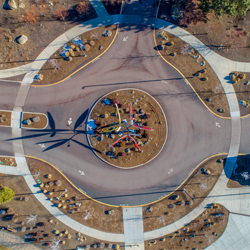

Roundabouts offer a higher level of safety compared to other types of at-grade intersections. Their design reduces conflict points, encourages lower speeds, and simplifies decision-making for drivers and pedestrians alike. Studies conducted in Europe, the UK, Australia, and the U.S. consistently show that roundabouts lead to fewer overall crashes and, more importantly, a significant reduction in injury-related collisions. This benefit extends to both motorists and pedestrians.
When comparing multilane roundabouts to signalized intersections, Federal Highway Administration’s data indicates a 32% decrease in total crashes and a 68% drop in injury-related collisions. The primary reason for this reduction is the near elimination of high-impact crash types, such as head-on, left-turn, and right-angle collisions—accidents that typically result in the most severe injuries. Research from other countries aligns with U.S. findings, showing overall crash reductions between 36% and 61%, while injury-related crashes drop by 25% to 87%.
The benefits of roundabouts extend beyond just improving traffic flow. A study by the Insurance Institute for Highway Safety estimated that if 10% of the signalized intersections in the U.S. were converted to roundabouts, Americans could have saved over 981 million hours in vehicle delays and more than 654 million gallons of fuel in 2018 alone.
Traffic Flow and Cost Efficiency
Roundabouts can handle approximately 30% more traffic than signalized intersections of a similar size, particularly during peak hours. Traffic signals often cause delays, especially for vehicles turning left or using side streets. In contrast, roundabouts maintain a continuous flow, allowing vehicles to proceed once a gap appears rather than waiting for a light to change.
Additionally, roundabouts eliminate the need for costly traffic signals, which require annual maintenance and electricity expenses ranging from $3,000 to $5,000.
Why Roundabouts Are Safer
Roundabouts function by directing vehicles counterclockwise around a central island, with entering traffic yielding to vehicles already in circulation. This design naturally slows vehicles to 15-20 mph in urban areas and 30-35 mph in rural areas, significantly reducing the severity of collisions. Due to their proven effectiveness, the Federal Highway Administration lists roundabouts as one of its evidence-based safety countermeasures.
Crash Reduction Data
Numerous studies have confirmed the safety benefits of roundabouts:
- U.S. Intersections Converted to Roundabouts
- 72%-80% reduction in injury crashes
- 35%-47% reduction in total crashes
(Retting et al., 2001; Eisenman et al., 2004; Rodegerdts et al., 2007)
- Higher-Speed Rural Intersections (40+ mph) Converted to Roundabouts
- 62% reduction in total crashes
- 85% reduction in injury crashes
(Isebrands & Hallmark, 2012)
- International Studies (Europe & Australia)
- 25%-87% reduction in injury crashes
- 36%-61% reduction in total crashes
(Rodegerdts et al., 2010)
- Estimated Impact in the U.S. (If 10% of Signalized Intersections Were Converted to Roundabouts in 2022)
- 47,000 crashes prevented
- 289 fatal crashes avoided
- Over 31,000 injury crashes prevented
(Eisenman et al., 2004)
Long-Term Safety Improvements
A 2019 study by the Insurance Institute for Highway Safety (IIHS) found that two-lane roundabouts become safer over time as drivers adjust to them. Research on roundabouts built in Washington state (2009-2015) found:
- 9% annual decrease in total crashes
- 33% annual decrease in serious injury crashes
(Hu & Cicchino, 2019)
Additionally, European research indicates that replacing conventional intersections with roundabouts reduces pedestrian crashes by 75% on average.
Types of Crashes at Roundabouts
A study of 39 U.S. roundabouts identified the most common crash types:
- Single-lane roundabouts: Majority of crashes involved entering-circulating conflicts.
- Multi-lane roundabouts: Most crashes involved exiting-circulating conflicts.
(Rodegerdts et al., 2007)
The Oregon Case: The Impact of Roundabouts
The U.S. is home to nearly 9,000 roundabouts, according to the Federal Highway Administration. In Oregon, the Department of Transportation (ODOT) oversees 15 roundabouts on state roads, while certain cities—particularly Bend—have embraced them extensively, with dozens in operation.
One of the latest roundabout projects was completed in Molalla, at the intersection of Toliver Road and Highway 213. Previously, this intersection relied on stop signs, often leading to significant traffic congestion. Around 13,000 vehicles pass through this area daily, with approximately 90% traveling north or south on the highway. Before the roundabout was introduced, drivers coming from Toliver Road faced wait times of 15 to 20 minutes due to long lines of vehicles.
Embracing Roundabouts in Bend, Oregon
Bend has embraced roundabouts as a core element of its traffic infrastructure. The concept first appeared in Central Oregon in the late 1960s, introduced at the Sunriver resort south of Bend as an efficient and aesthetically pleasing alternative to traditional intersections.
Today, Bend leads the state with 42 roundabouts and counting, surpassing any other city in Oregon. Notably, there is not a single signalized intersection west of the Deschutes River, a testament to the city’s commitment to roundabout implementation.
Proven Safety Benefits in Bend
Bend’s roundabouts have led to significant crash reductions, as demonstrated in two key intersections:
- Murphy Road & Parrell Road (Converted from a two-way stop)
- Before Roundabout (5 years): 6 injury crashes + 1 property damage crash
- After Roundabout (5 years): 1 injury crash + 1 property damage crash
- Reed Market Road & 15th Street (Converted from a signalized intersection)
- Before Roundabout (5 years): 26 injury crashes + 65 property damage crashes
- After Roundabout (5 years): 8 injury crashes + 16 property damage crashes
Roundabouts and Public Art
Beyond their functional benefits, Bend’s roundabouts have also become a hub for public art. The Art in Public Places (AIPP) initiative, in collaboration with the Bend Foundation, City of Bend, and private donors, launched an extensive roundabout art project. Some of the earliest installations include:
- “Sunrise Spirit Column” (2001) by David Govedare – Located at Mt. Washington Drive & NorthWest Crossing Drive.
- “Redsides” (2003) by Miles Addison Pepper – Installed at Simpson Avenue & Colorado Avenue.
Public Opinion on Roundabouts
One of the biggest challenges in implementing roundabouts is public perception. Many people mistake modern roundabouts for traditional traffic circles, which have a reputation for being confusing and inefficient. This misunderstanding has led to initial resistance in many communities, with numerous roundabout proposals being rejected due to misconceptions.
However, public opinion often shifts after construction. In a study of three communities where single-lane roundabouts replaced stop sign-controlled intersections:
- Before installation, only 31% of drivers supported the change.
- Shortly after construction, 63% of drivers expressed approval.
This shift suggests that once drivers experience the benefits firsthand—improved safety, smoother traffic flow, and reduced delays—they are more likely to support roundabouts as a long-term traffic solution.
Difficulties Drivers Face and Police Recommendations
Bend Police have issued a reminder about the proper use of the two-lane roundabout at Butler Market, Empire Avenue, and 27th Street, an area known for frequent confusion and accidents. The main issues identified include:
- Lane Switching: Drivers should not change lanes within the roundabout, as this leads to accidents and confusion.
- Understanding Lane Functions: Some drivers are unclear about whether they can continue through the roundabout or must exit, depending on their lane.
- Left lane: Allows going straight or turning left (second or third exit).
- Right lane: Only allows turning right or going straight (first or second exit).
Additionally, police emphasize the importance of signaling when exiting the roundabout, whether it’s a single-lane or multi-lane roundabout. Always signal your intentions and stay aware of other vehicles, especially when exiting from the inside lane.
Common Causes of Accidents in Roundabouts
A study reviewing crashes at 39 roundabouts across the United States identified the most common types of accidents as:
- Entering-Circulating Collisions: Accidents that occur when vehicles enter the roundabout and collide with those already circulating.
- Exiting-Circulating Collisions: Accidents involving vehicles exiting the roundabout while others are still circulating.
- Rear-End Collisions: Crashes caused by vehicles following too closely.
For single-lane roundabouts, the majority of accidents were entering-circulating crashes. In contrast, multi-lane roundabouts saw most accidents as exiting-circulating crashes.
Further research on fatal crashes in the U.S. and injury crashes in Washington and Wisconsin found that; motorcycle crashes, crashes involving fixed objects, and crashes related to impaired driving were disproportionately represented in the data, indicating higher risks for these factors at roundabouts.
Legal Regulations for Roundabouts in Oregon
In Oregon, the offense of failure to yield the right of way within a roundabout is defined as follows:
A person commits this offense if they operate a motor vehicle on a multilane circulatory roadway and:
- Overtake or pass a commercial motor vehicle
- Drive alongside a commercial motor vehicle
- Fail to yield the right of way to a second vehicle that is lawfully exiting the roundabout from a position ahead and to the left of their vehicle.
However, this law does not apply if a traffic control device indicates that the driver should take other actions.
Penalty: Failure to yield the right of way within a roundabout is classified as a Class C traffic violation. (2001 c.464 §5; 2011 c.85 §1).
Upcoming Roundabout Projects in Oregon
Lafayette (Highway 18 & Lafayette Highway Intersection)
- Project: Construction of a roundabout at the intersection of OR-18 and Lafayette Highway (OR-233).
- Reason: An increase in motor vehicle accidents at this intersection, with 26 crashes reported in 2023, 20 in 2022, and 14 in 2021.
- Traffic Volume: Traffic has steadily increased, with annual daily traffic rising from 15,500-15,900 (2018-2021) to 17,291 in 2022 and 17,758 in 2023.
- Safety Improvements: The Oregon Department of Transportation is also making updates at McDougall Corner at the intersection of Highways 18 and 99W.
Roseburg (Garden Valley Blvd & Melrose Road Intersection)
- Project: Construction of a roundabout at the intersection of Garden Valley Blvd and Melrose Road.
- Timeline: Construction will begin in 2026.
Sisters (US 20 & Locust Street Intersection)
- Project: The Locust Roundabout will be a single-lane roundabout at the intersection of US 20 and Locust Street.
- Reason: This roundabout will help with vehicle collisions, as the US 20/Locust Street intersection sees the highest number of crashes in the city.
- Additional Features:
- A safer route for commercial trucks and traffic.
- Enhanced pedestrian and bicycle crossings.
- New sidewalks connecting adjacent side streets.
- A multi-use path along Locust Street.
- The roundabout will slow down vehicles approaching the town, reducing congestion and maintaining the pedestrian-friendly quality of Sisters’ downtown core.
What are Roundabout Rodeos?
A Roundabout Rodeo is an educational event where semi-truck drivers can practice navigating roundabouts before they are fully implemented. These events, organized by the Oregon Department of Transportation (ODOT), help truck drivers understand how to safely maneuver through roundabouts, ensuring smoother traffic flow and reducing accidents. Additionally, ODOT uses 3D-rendered videos to demonstrate how traffic will move through upcoming roundabouts.
If you’re unfamiliar with how to navigate a roundabout, it is recommended to check whether your city hosts a Roundabout Rodeo to take advantage of this learning opportunity.