


You’ve probably come across those “Online Injury Calculators” — quick, convenient tools that claim to estimate how much your case is worth. While they can be a helpful starting point, it’s essential to understand their value and limitations.
What’s good about online injury calculators?
-
-
-
- ✅ They give you a rough ballpark to begin thinking about your case.
- ✅ They help you ask the right questions (like: have I included future medical expenses or lost earnings?).
- ✅ They may highlight the distinction between economic and non-economic damages.
-
-
What’s not so great?
-
-
-
- ⚠️ The estimates can be way off — too high, or too low.
- ⚠️ They might give you unrealistic expectations that don’t reflect your unique situation.
- ⚠️ They’re no substitute for legal advice from a qualified personal injury attorney.
- ⚠️ In some cases, they’re marketing tools — if they ask for sensitive data or payment methods before offering real insight, proceed with caution.
-
-
Understanding Economic and Non-Economic Damages in Injury Claims
When someone is injured in an accident, the law in Washington recognizes two distinct types of compensation: economic and non-economic damages.
Economic damages refer to financial losses that can be documented and proven. These are costs with measurable value, such as:
-
-
-
- Hospital bills and medical treatment costs
- Lost wages from time missed at work
- Reduced ability to earn income in the future
- Out-of-pocket expenses for property repair or replacement
-
-
By contrast, non-economic damages are more personal and harder to quantify. These are the intangible losses — real, but not tied to a receipt or invoice — and may include:
-
-
-
- Chronic pain or physical discomfort
- Emotional trauma and psychological suffering
- Impact on family relationships or companionship
- Permanent disfigurement or disability
- Loss of enjoyment in daily life activities
-
-
In more serious injury cases, future medical care is a significant part of a personal injury claim. These projected costs might include:
-
-
-
- Surgery and diagnostic procedures
- Long-term medication or pain management
- Ongoing mental health support for the injured person or their family
- In-home nursing or rehabilitation services
- Follow-up appointments and specialized care
- Modifications to the home to accommodate new physical needs
- Assistive devices or durable medical equipment
- Nutritional planning or medically necessary clothing
- Transportation to and from medical providers
-
-
Whether the damage is financial or emotional, temporary or permanent, all these elements affect the total value of your personal injury claim.
How Car Accident Settlements Are Calculated: The Multiplier Method, Explained
After a car accident, one of the biggest questions is: what’s a fair value for any damages and injuries incurred as a result of the accident? While no formula can predict the exact outcome, many insurance companies and attorneys use a basic tool called the multiplier method to estimate the value of a personal injury claim.
The Formula at a Glance
It typically looks like this:
(Economic Losses) × Multiplier + Non-Economic Losses = Estimated Settlement
Let’s break that down.
-
-
-
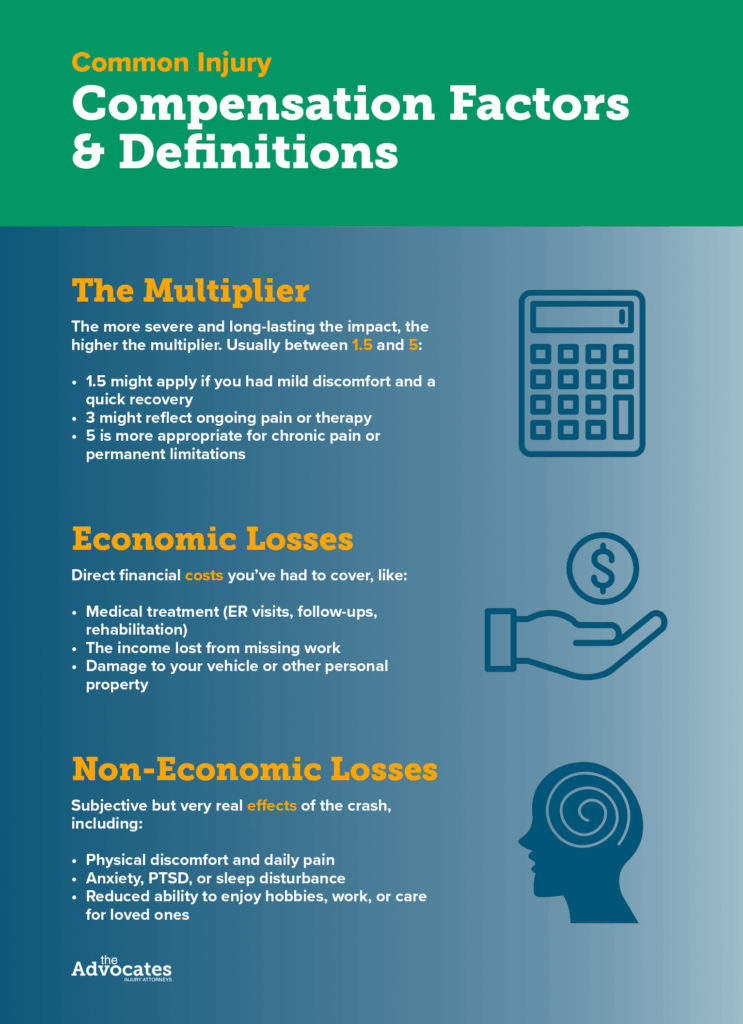
- Economic Losses
These are the direct financial costs you’ve had to cover, like:-
- Medical treatment (ER visits, follow-ups, rehabilitation)
- The income you lost from missing work
- Damage to your vehicle or other personal property
-
- The Multiplier
A number, usually between 1.5 and 5, accounts for your non-financial suffering. The more severe and long-lasting the impact, the higher the multiplier. For example:-
- 1.5 might apply if you had mild discomfort and a quick recovery
- 3 might reflect ongoing pain or therapy
- 5 is more appropriate for chronic pain or permanent limitations
-
- Non-Economic Losses
These are the subjective but very real effects of the crash, including:
-
- Physical discomfort and daily pain
- Anxiety, PTSD, or sleep disturbance
- Reduced ability to enjoy hobbies, work, or care for loved ones
-
- Economic Losses
-
-
Do you like this article?
If you liked this article, you might like our others:
What car is best for you? What are the common safety standards that American cars do that Foreign Cars dont’t? We cover these topics and more in this article.
American vs. Foreign Cars: Safety Standards and What They Mean for You
The Cybertruck, a pinicle of Elon’s imagination, what are the issues? Learn what the issues are and more in this article.
The Many Issues with Tesla’s Cybertruck
Example with Adjusted Numbers
Let’s say the crash left you with the following:
- $7,200 in hospital and therapy costs
- $3,800 in lost wages
- $1,500 in vehicle repairs
Total economic losses: $12,500
Your injuries were moderate — perhaps not life-threatening, but painful and disruptive — so a multiplier of 3.5 is applied:
$12,500 × 3.5 = $43,750
Now, suppose your non-economic damages — mental strain, chronic headaches, inability to drive for months — are estimated at $11,000.
Total Estimated Settlement: $43,750 + $11,000 = $54,750
A Word of Caution: Who Picks the Multiplier?
The multiplier seems simple, but here’s where things get tricky. How do you know it’s accurate if you assign the number without reference?
Maybe you’re in constant pain and feel a 5 is justified. Or maybe you’re in some pain and still assume there are worse cases out there, so you modestly pick a 2.
That’s the danger of a self-assigned multiplier: it lacks a scale. What’s unbearable to you might seem “moderate” to an insurance adjuster who’s never lived your pain.
This is why relying on the multiplier alone isn’t enough, especially if you do it alone. Legal guidance helps translate the human side of your injury into a number that truly reflects what you’ve lost, not just on paper, but in your real life.
Not All Injuries Are Visible, and That Matters
When someone breaks a bone, the X-ray becomes the star of the claim. There it is, in black and white — clear, measurable, and indisputable. But for many Washingtonians, the real cost of an injury doesn’t show up on a scan.
A fractured wrist may look the same on two people’s charts — but what about the barista who can’t grip a coffee pitcher anymore? Or the grad student who had to drop out mid-semester because they couldn’t write or type? Or the warehouse worker now dealing with chronic nerve pain that won’t let him sleep?
These are invisible damages — the kind that insurance adjusters often overlook:
-
-
-
- Losing your place in a certification program because of missed practical hours
- The mental toll of feeling “useless” at home or at work
- Social isolation after weeks of immobility or dependence on others
- Lingering anxiety every time you ride in a car again
- Delayed life plans — from job interviews to moving out — all postponed by one injury
- Canceling plans out of fear the pain will flare up again
- Being labeled as “fine” by others because there’s nothing visibly wrong
-
-
These aren’t “soft” losses. They’re real, lived, and often more disruptive than the injury itself.
That’s why injury compensation in Washington shouldn’t be a one-size-fits-all formula. Your experience matters. Your limitations matter. Your story matters.
The cast comes off — but sometimes, the impact lingers.
What Is the Per Diem Method in Injury Settlements?
If you’ve ever received a daily allowance from your employer for meals or lodging while traveling, you might already be familiar with the concept of a per diem. In personal injury law, the term takes on a different — but similarly structured — meaning.
The per diem method assigns a daily monetary value to your pain and suffering. The idea is simple: if an injury causes ongoing discomfort, emotional distress, or disruption to daily life, then each day lived under those conditions holds a compensable value.
How the Per Diem Method Works
Let’s say your daily pain and emotional struggle after an accident is valued at $200 per day. If your recovery — or the period during which you experienced pain — lasted for 182 days (roughly six months), your pain and suffering compensation would be calculated as:
$200 x 182 days = $36,400
This amount would then be added to your economic damages to estimate a full settlement value.
Is the Per Diem Method the Same as the Multiplier Method?
No — they are separate methods, and usually only one is used, not both.
-
-
-
- The multiplier method takes the sum of your economic damages (medical bills, lost wages, etc.) and multiplies that by a number based on the severity of your injury.
- The per diem method focuses only on non-economic damages like pain and suffering and values them day by day.
-
-
Stay Updated — Follow Us on Facebook

Same Injury, Different Lives: Why Context Changes Everything
When people think of personal injury claims, they often imagine a straightforward equation: broken bone equals a certain payout. But the reality is far more complex. Even when two — or three — people walk away from the same crash with the exact same injury, their cases can unfold in wildly different directions. Why? Because the true weight of an injury isn’t just in what shows up on an X-ray — it’s in what the person loses because of it.
Three Washingtonians. Same crash. Same vehicle make. Same wrist fracture requiring surgery. And yet, each of their injury claims could look drastically different — because what truly shapes a case isn’t just the diagnosis, but how that injury disrupts someone’s life.
Jared, 34, Spokane
Occupation: Remote IT Technician
Complication: Weeks later, the surgical site became infected, leading to a second hospitalization and a much longer recovery timeline (over 4 months instead of 6 weeks).
Impact:
-
-
-
- Missed income due to unpaid medical leave.
- Higher medical costs from extended care and antibiotics.
- Mental stress and physical exhaustion from managing a preventable infection.
-
-
The bottom line: It was the same injury, but a rare complication turned a “straightforward” recovery into a months-long ordeal.
Kaia, 21, Seattle
Occupation: College athlete on a full sports scholarship
Accident: Same car, same rear-end collision
Impact:
-
-
-
- Forced to withdraw from her sport for the season, risking scholarship eligibility
- Missed NCAA qualifiers and future sponsorship opportunities
- Emotional toll of losing momentum in a short athletic career window
-
-
Bottom line: Kaia’s injury didn’t just hurt — it jeopardized her future. The long-term loss isn’t just financial, it’s career-defining.
Natalie, 49, Tacoma
Occupation: Single mom of three, works in home caregiving
Impact:
-
-
-
- Couldn’t drive for weeks — no daycare drop-offs, no work shifts
- Lost income and even risked losing her caregiving clients
- Needed help at home: diaper changes, bottle prep, lifting
-
-
Bottom line: For Natalie, the injury made survival harder. The value of her claim isn’t about the wrist alone — it’s about the ripple effects on her kids and livelihood.
Curious about how injury calculators actually compare? We tested three made-up profiles across several online tools—and the results varied more than you might expect. [See the full comparison here.]
Bottom Line: Your Injury Story Deserves More Than a Formula
Online calculators might offer a quick snapshot, but real cases are built on real lives. An injury on paper might look the same for everyone. But when it sidelines, the true impact goes far beyond numbers.
That’s why personal injury law isn’t one-size-fits-all. It’s personal. And when it comes to securing the compensation you deserve, nothing replaces an experienced legal team that knows how to tell your full story, not just the X-rays, but the invisible damages too.
What might your claim be worth? Don’t guess. Let’s talk. No pressure. Just clarity.
Your story matters — and we’re here to listen. Schedule a free consultation today.